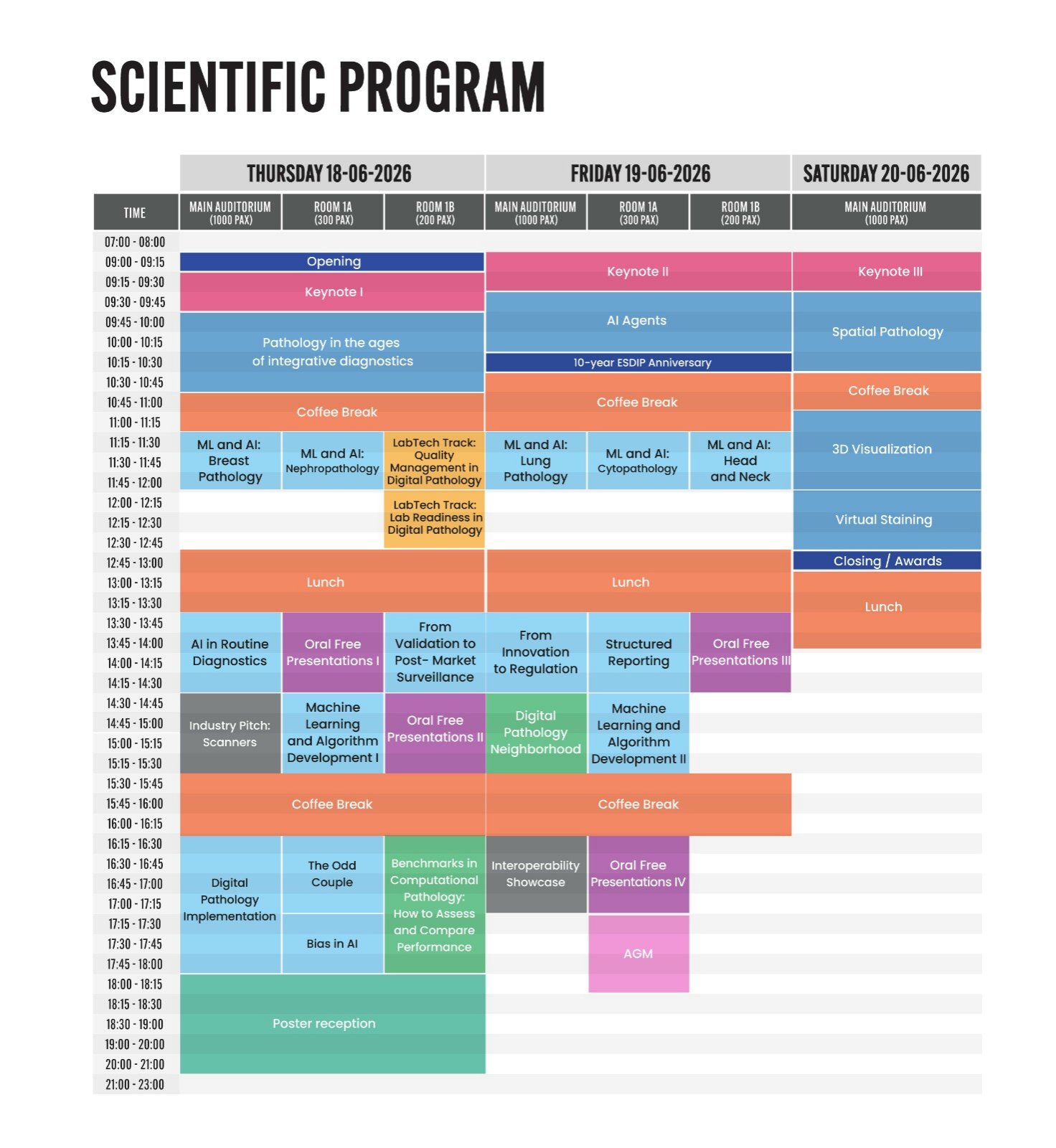
Scientific Program


INVITED SPEAKERS
Markus Plass Austria
Peter Regitnig Austria
Norman Zerbe Germany


INVITED SPEAKER
Laura Rubbia-Brandit Switzerland


INVITED SPEAKER
Arsela Prelaj Italy


INVITED SPEAKER
Balázs Ács Hungary
"Computational Breast Pathology: Ready for Prime Time?"
ABSTRACTS
11:35 Mateusz Maniewski
AI-assisted algorithm for reflex testing in equivocal HER2 immunohistochemistry
11:45 Afzan Adam
Spatial Integration of Atypical Mitotic Hotspots and Tumor-Infiltrating Lymphocytes for Survival Stratification in Breast Cancer.


INVITED SPEAKERS
Frederik Deman Belgium
"Making AI Work - Not in Theory, but in Your Lab: lessons learned after 3y of experience"
Paul van Diest The Netherlands
ABSTRACTS
14:10 Judith Ingrid
Building PortrAIt: A Multidisciplinary Framework to Accelerate AI Development and Routine Implementation in Digital Pathology
14:20 Hannah Markham
A multi-centre validation of the Ibex Prostate AI Pathology system compared to expert uropathologist reporting: Cancer Histology Artificial Intelligence Reliability Study (IP6-CHAIROS)


INVITED SPEAKERS
Anne Vincent-Salomon France
Markus Plass Austria
Peter Regitnig Austria
Diana Montezuma Portugal
Thomas Mairinger Germany


INVITED SPEAKER
Peter Boor Germany
ABSTRACTS
11:35 Hrafn Weishaupt
An unsupervised learning approach to resolving mislabeling of histological stains
11:45 Renaldas Augulis
Computational Morphometrics to Predict Renal Allograft Survival from Biopsy Histology Images

ABSTRACTS
13:30 Carlijn Lems
Pathologists versus AI copilots in digital pathology: evaluation on the DALPHIN multicentric open benchmark
13:40 Ye Wenjing
Spatial profiling and prognostic value of CD66+ neutrophils in colorectal cancer patients with synchronous and metachronous liver metastases
13:50 Mateusz Maniewski
Clinical relevance of AI-based reflex testing PD-L1 in non-small cell lung cancer
14:00 Garazi Serna Spain et al.
Multimodal computational pathology for risk stratification in colorectal cancer
14:10 Puneet Arora
Spatial Profiling of the Tumor Microenvironment to Identify Features Associated with Upgrade of Breast Ductal Carcinoma In Situ
14:20 Mónica Curado
The impact of inking colour selection on digital pathology efficiency


INVITED SPEAKER
Vincenzo Della Mea Italy
ABSTRACTS
14:50 Mario Parreno-Centeno
Artefact-Aware Fine-Tuning Improves Accuracy and Robustness in Histopathology Foundation Models
15:00 Loïc Le Bescond
Leveraging Multimodal Foundation Models for Scalable Tumour Subtype Classification from H&E Whole-Slide Images
15:10 Gaspar Faure
PlacentaBench: 10K+ Whole-Slide Images for Evaluating Foundation Models Transferability to Placental Pathology
15:20 Nefise Uysal
AI-Based Gleason Grading: From Section-Level Models to Patient-Level Gleason Score


INVITED SPEAKERS
Alessandro Caputo Italy
"Computational pathology as a second language: a bilingual introduction from pathology and computer science"
Salma Dammak The Netherlands
"Computational pathology as a second language: a bilingual introduction from pathology and computer science"
ABSTRACTS
16:35 Jianan Chen United Kingdom  Adrienne Flanagan United Kingdom et al.
A Multimodal Knowledge-Enhanced Clinical Decision Support Platform for Diagnosing Sarcoma and its Mimics
16:45 Maximilian Koeller  Felix Kueng Austria
Kidney Histo-Morphology Revisited: Machine Learning Based Morphological Reasoning And Its Limitations
16:55 Swapnil Bhat, Nayantrishna Nath
Can Freely Accessible Large Language Models Interpret Histopathology Images in Resource-Limited Settings? A Multi-Model Benchmarking Study
17:05 Melis Erdal Cesur, Rolf Harkes  Rolf Harkes The Netherlands
CODEX-Derived Cell Type Labels for H&E-Based Spatial Single-Cell Analysis in Breast Cancer

ABSTRACTS
17:35 Carman Tenorio
Training of State-of-the-Art Deep Learning Models With and Without Ambiguous Regions for Nuclei Instance Segmentation
17:45 Antonia Syrnioti
Human-AI Synergy in Computational Pathology: Trust, Bias, and Implementation Challenges


INVITED SPEAKERS
Vincenzo Della Mea Italy
Silje Elisabeth Kristiansen Norway
Anne Vincent-Salomon France


INVITED SPEAKERS
Markus Plass Austria
Peter Regitnig Austria
"Going Digital, Staying Compliant: The ISO 15189 Challenge"
Yosep Chong South Korea


INVITED SPEAKER
Christian Baumgartner Austria
ABSTRACTS
13:50 Jennifer Antonythasan
Organizational Readiness for AI in Diagnostic Pathology: A Regional Pre‑implementation Survey in Western Norway
14:00 Cora Lohse
Regulatory-Compliant, Yet Flexible Digital Pathology Workflows for a Contract Research Organization
14:10 Frédérique Meeuwsen
A roadmap to implementation of in-house developed computational pathology algorithms
14:20 Phoenix Wilkie
Redefining how ethics is taught in medicine with the advent of AI

ABSTRACTS
14:30 Navin Vicent
Validation of Diagnostic Artificial Intelligence Models for Prostate Pathology in a Middle Eastern Cohort
14:40 Flavio Di Lisio
Data-efficient AI for the detection of duodenal neoplasia: a multi-centre study
14:50 Alexander Szabados
A Unified Model for Pan‑Cancer H&E Tissue Segmentation Across 17 Organs
15:00 Giovanni Laganà
Predicting spatial transcriptomics from histology images of inflammatory bowel conditions
15:10 Kerem Cavit
Automated Digital Quantification of CD3⁺ and CD8⁺ Immune Infiltrates in Colorectal Carcinoma Using a Standardized Image Analysis Algorithm
15:20 Javier Baroja
Deep Learning-Based Morphological Profiling of Lymph Node Metastasis Improves Prognostic Stratification in Stage III Colorectal Cancer


INVITED SPEAKERS
Marius Linguraru United States of America
Spyridon Bakas United States of America
Nadieh Khalili The Netherlands
Adam Shephard United Kingdom
"The MIDOG Challenge: A Competitor’s Perspective"
Sangjeong Ahn South Korea
Sanket Kachole United Kingdom
"HANCOTHON 2025 : A MICCAI Challenge on Predicting Recurrence and Survival Using Multimodal Head and Neck Cancer Data"
Francesco Ciompi Italy
Norman Zerbe Germany


INVITED SPEAKER
Julien Calderaro France


INVITED SPEAKER
Guillaume Jaume Switzerland
ABSTRACTS
09:50 Vishal Jain
Annotation-Free Foreground-Background Separation and Quality Control in Histopathology
10:00 Nisha Chaudhary
A calibrated and spatially aware agentic framework for head and neck cancer pathology


INVITED SPEAKER
Junya Fukuoka Japan
ABSTRACTS
11:35 Lucas Farndale
Self-Supervised AI Reveals a Hidden Landscape of Prognostic Spatial Patterns in Multiplex Immunofluorescence Images
11:45 Farzaneh Seyedshahi
Cross-Domain Validation of a Resection-Trained Self-Supervised Model on Multicentre Mesothelioma Biopsies


INVITED SPEAKERS
Oscar Freyer Germany
"Is EU Regulation Fit for Innovative AI Systems in Healthcare?"
Jens Habermann Germany


INVITED SPEAKERS
Chan Kwon Jung South Korea
Bassma El Sabaa Egypt
Gonzalo de Toro Chile


INVITED SPEAKER
Yosep Chong South Korea
ABSTRACTS
11:35 Wei-Lei Yang
Artificial Intelligence-Assisted Urine Cytology Reduces Review Time in High-Complexity Cases Without Diagnostic Compromise
11:45 Gennaro Acanfora
Deep Learning-Based Classification in Lymph Node Fine Needle Cytology


INVITED SPEAKER
Markus Plass Austria
ABSTRACTS
13:50 Devansh Lalwani
Bridging the Gap: Pathologist and Clinician Perspectives on Synoptic Reporting in Histopathology
14:00 Devansh Lalwani
TuroAssist: An Agentic Framework for Accelerating Synoptic Report Generation in Digital Pathology
14:10 Serdar Balci
A Skill for Large Language Models to Evaluate Pathology Report Quality
14:20 Martina Haberecker
User Adoption of Structured Pathology Reporting and Impact on Report Accuracy in Routine Lung Cancer Diagnostics

ABSTRACTS
14:30 Debora Cafaro
Mapping Hidden Resistance: An Explainable AI Model for Spatial Prediction of Immunotherapy Response in MSI Colorectal Cancer
14:40 Robert Spaans
CHIMERA: A Multimodal Benchmark for Prognostic Modeling Using mpMRI, Histopathology, and Clinical Data in Prostate Cancer
14:50 Kristijan Skok
A Novel Prediction tool (AIFORIA) for Classifying Spindle Cell Lesion subtypes using Deep Learning on H&E Sections
15:00 Pierre Allaume
High Performance Deep-Learning Model for the diagnosis of Auto-Immune Hepatitis based on histological Whole Slide Images
15:10 Farzaneh Seyedshahi
mIF-CellFormer: Transformer Learning of Cell-Level Marker Tokens from Multiplex Immunofluorescence Images
15:20 Marek Oerlemans
Multimodal Deep Learning for DCIS Risk Prediction: Integrating Histopathology and RNAseq

ABSTRACTS
16:15 Chukwunwendu Adina
Integrating Digital Pathology and Infectious Disease Care to Improve Diagnosis of HIV-Associated Malignancies in Resource Limited Settings
16:25 Sara Bristow
A large-scale, multi-target deep learning model for virtual genomic and molecular risk profiling in colorectal cancer
16:35 Laura Sironi
Quantum Steps into Digital Pathology: Hybrid Quantum-Classical Neural Networks for Cancer Image Analysis
16:45 Jaya Jain
Multi-magnification scanning of bone marrow aspirate smears enabled by Edge AI at the scanner is a boon for digitisation of haematology labs
16:55 Dmitry Loos
Use of Digital Image Analysis Tools for Assessment of TROP2 Expression in Non-Small Cell Lung Cancer
17:05 Ilán Carretero
Beyond Patch-Level Bias: Robustness of Pathology Foundation Models in Whole-Slide Image Classification


INVITED SPEAKER
Ali Khurram United Kingdom
"Computational and digital analysis of head and neck lesions"
ABSTRACTS
11:35 Camille Boulagnon-Rombi
Impact of Artificial Intelligence Assistance on Combined PD-L1 Scoring on Whole Immunohistochemical Slide Image of tumors
11:45 Sanket Kachole
Multi-FRUGAL: Multimodal Flexible Redundancy-aware Unified GAted Learning for Head and Neck Cancer Prognosis

ABSTRACTS
13:30 Oskar Thaeter
Thumbnail-Based Special Stain Classification
13:40 Kristijan Skok
Frozen Section 2.0 ? - Confocal Microscopy Enables Confirm-if-Positive Margin Assessment in Robotic Prostatectomy
13:50 Andrea Camilloni
Development and Validation of a Multimodal AI Model to predict Biochemical Recurrence of Prostate Cancer after Primary Treatment
14:00 Marie Arrivat
Leveraging Whole Slide Difficulty in Multiple Instance Learning to Improve Prostate Cancer Grading
14:10 Judith Lefkes
Insights from the UNICORN Challenge: Evaluating Foundation Models for Imaging in Computational pathology, Radiology, and Natural language
14:20 David Steiner  Kenneth Philbrik USA
Report-style text generation for whole side images using a multimodal open weight vision-language model.


INVITED SPEAKER
Joe Yeong Singapore
"My journey When Immunology meets AI Pathology: The Impact of cross-disciplinary research"


INVITED SPEAKER
Bernadette Stolz Pretzer Germany
ABSTRACTS
09:50 Garazi Serna
Graph-based spatial modeling of early tumor–immune remodeling predicts response to HER2 blockade
10:00 Melinda Lillesand
Spatial immune profiling and AI-based classifiers identify predictors of BCG therapy outcome in high-risk non-muscle invasive bladder cancer
10:10 Jelica Vasiljevic
Beyond Pixels: Leveraging High-Resolution Spatial Transcriptomics in Core-Needle Biopsies to Map the Cellular Organisation of the Tumour Microenvironment
10:20 Swann Ruyter
When High Correlation Isn’t Enough: Rethinking Evaluation in H&E‑Based Gene Expression Prediction


INVITED SPEAKER
Jonathan Liu United States of America
"Non-destructive 3D pathology for precision oncology"
ABSTRACTS
11:20 Agni Papamaloni
The Future of Renal Pathology Education: Development of 3D Models for Teaching Glomerular Disease
11:30 Maya Utermöhlen
Evaluation of Lymph Node Status through Virtual 3D Histology using X-Rays
11:40 Melek Büyükgök
3D Tumor Mapping and Grade Heterogeneity Metrics in Radical Prostatectomy: A Joint Pathology–Computation Feasibility Protocol for Spatially-Informed Reporting
11:50 Silvestri
A scalable end-to-end pipeline for 3D digital pathology


INVITED SPEAKER
Leena Latonen Finland
"Transforming histopathology using generative AI -based virtual staining - challenges and opportunities"
ABSTRACTS
12:20 Ruisi Li Singapore et al.
H&E 3.0: An AI-Driven, Chemical-Free Virtual Histology Solution Enabling Worldwide Multiomics Profiling
12:30 Devansh Lalwani
A Pathology-Specific Fréchet Inception Distance for Whole Slide Image Quality Assessment Using Foundation Model Features


INVITED SPEAKERS
Markus Plass Austria
Peter Regitnig Austria

prgora AAG